|
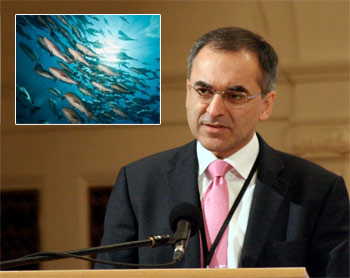
Pavan Sukhdev, head of the UN Environment Program which in turn directs the Green Economy initiative. (Photo: ISSD/UN)
Ocean fish could disappear in 40 years: UN
 WORLDWIDE WORLDWIDE
Tuesday, May 18, 2010, 23:30 (GMT + 9)
The world faces the nightmare possibility of fishless oceans by 2050 unless fishing fleets are slashed and stocks allowed to recover, United Nations (UN) experts warned Monday.
"If the various estimates we have received... come true, then we are in the situation where 40 years down the line we, effectively, are out of fish," Pavan Sukhdev, head of the UN Environment Program's green economy initiative, told journalists in New York.
A Green Economy report due later this year by UNEP and outside experts argues this disaster can be avoided if subsidies to fishing fleets are slashed and fish are given protected zones -- ultimately resulting in a thriving industry.
The report, which was opened to preview Monday, also assesses how surging global demand in other key areas including energy and fresh water can be met while reventing ecological destruction around the planet.
UNEP director Achim Steiner said the world was "drawing down to the very capital" on which it relies.
However, "our institutions, our governments are perfectly capable of changing course, as we have seen with the extraordinary uptake of interest. Around, I think it is almost 30 countries now have engaged with us directly, and there are many others revising the policies on the green economy," he said.
Environmental experts are mindful of the failure this March to push through a worldwide ban on trade in bluefin tuna, one of the many species said to be headed for extinction.
Powerful lobbying from Japan and other tuna-consuming countries defeated the proposal at the Convention on International Trade in Endangered species (CITES) conference on endangered species in Doha.
But UNEP's warning Monday was that tuna only symbolizes a much vaster catastrophe, threatening economic, as well as environmental upheaval.
One billion people, mostly from poorer countries, rely on fish as their main animal protein source, according to the UN.
The Green Economy report estimates there are 35 million people fishing around the world on 20 million boats. About 170 million jobs depend directly or indirectly on the sector, bringing the total web of people financially linked to 520 million.
According to the UN, 30 per cent of fish stocks have already collapsed, meaning they yield less than 10 per cent of their former potential, while virtually all fisheries risk running out of commercially viable catches by 2050.
Currently only a quarter of fish stocks -- mostly the cheaper, less desirable species -- are considered to be in healthy numbers.
The main scourge, the UNEP report says, are government subsidies encouraging ever bigger fishing fleets chasing ever fewer fish, with little attempt made to allow the fish populations to recover.
The annual USD 27 billion in government subsidies to fishing, mostly in rich countries, is "perverse," Sukhdev said, since the entire value of fish caught is only USD 85 billion.
As a result, fishing fleet capacity is "50 to 60 per cent" higher than it should be, Sukhdev said.
Creating marine preservation areas to allow female fish to grow to full size, thereby hugely increasing their fertility, is one vital solution, the report says.
Another is restructuring the fishing fleets to favor smaller boats that -- once fish stocks recover -- would be able to land bigger catches.
"What is scarce here is fish," Sukhdev said, "not the stock of fishing capacity."
AFP
editorial@seafood.media
www.seafood.media
|
|





 Print
Print