|
The ghost of the Northwest Pacific is actively haunting the Southwest Atlantic. Decades ago, the Sea of Japan harbored one of the most prolific cephalopod fisheries on the planet; today, the population of the Japanese flying squid (Todarodes pacificus) is a tragic fraction of its historic abundance.
Driven to the brink by a toxic combination of rising ocean temperatures and fragmented international governance, Japan's catch plummeted from its peak of 400,000 tons in 1996 toward a systemic collapse. What in the 1990s was a solid baseline of between 200,000 and 400,000 metric tons (MT) dissolved to less than 68,000 tons in 2016. By 2017, Japan's domestic catch reached an all-time low of 47,000 tons, and recently, regional catches in the primary historical fishing grounds have hovered around a catastrophic ~13,500 tons (a minuscule 5.4% of its historical peak). The depletion of spawning stocks, the warming of deep ocean currents, and a total lack of binding international coordination forced Japan to rely heavily on foreign imports and to turn desperate glances toward experimental artificial aquaculture.
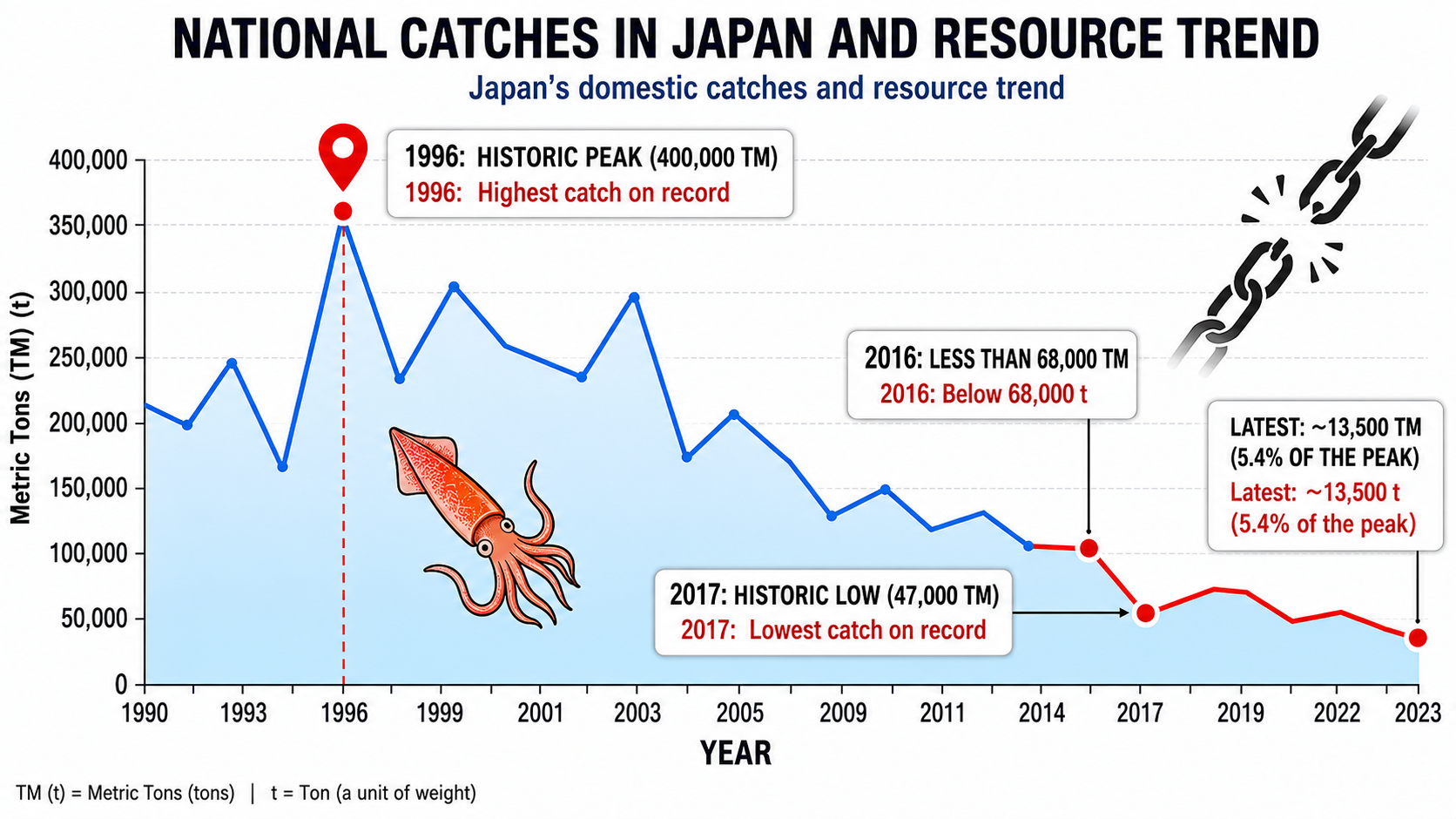
Enlarge the image to view it at full scale
Today, history is repeating itself aggressively in the South Atlantic. The Argentine illex squid (Illex argentinus)—the second-largest cephalopod fishery in the world—is caught in exactly the same ecological and regulatory downward spiral. The Illex squid exhibits the same patterns of vulnerability, characterized by highly volatile historical catches and abrupt declines in annual yields, exposing the fragility of a resource subjected to heavy pressure without unified governance. However, while the warning lights are flashing red, a paralyzing combination of regional geopolitical standoffs and an alarming short-term domestic regulatory myopia is blocking the transboundary scientific cooperation necessary to save the species.
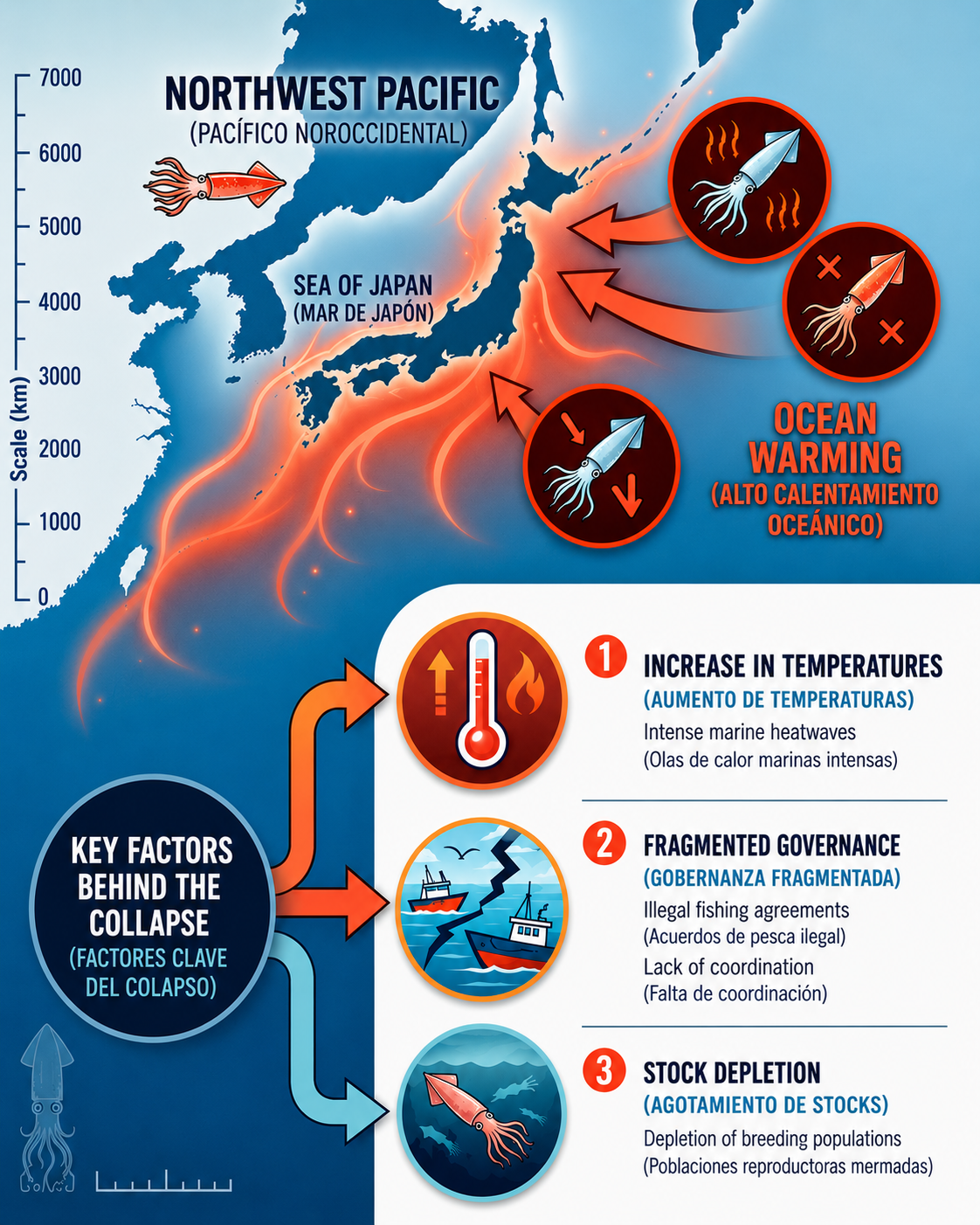
Parallel Crises: The Anatomy of a Dual Collapse
The vulnerabilities linking the failing Japanese fishery to the threatened Argentine illex squid encompass identical ecological weaknesses and legal vacuums:
-
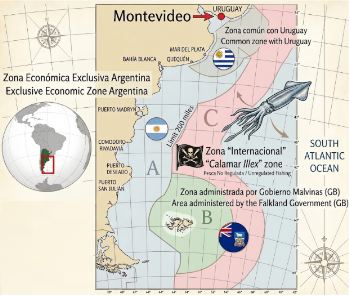
The Regulatory Vacuum on the High Seas (The Governance Blind Spot and Refuge for Fishing Impunity): The Illex argentinus is a classic straddling stock. The squid constantly migrates across the invisible border separating Argentina's 200-nautical-mile Exclusive Economic Zone (EEZ) from unmanaged international waters. Just outside Argentina's maritime border, anchored in this governance blind spot and refuge for fishing impunity, sits a massive armada of foreign distant-water jigging vessels. Because the Southwest Atlantic remains the only major marine area in the world without a Regional Fisheries Management Organization (RFMO), there are no international catch limits, quotas, or applied seasons on the high seas, allowing hundreds of industrial vessels to conduct unrestricted extraction.
-
Hypersensitivity to Climate Change: Both species are "annual semelparous" organisms—meaning they live for exactly one year, reproduce only once, and die. Consequently, the continuity of the entire species depends solely on the environmental survival of the eggs and paralarvae from that single year. Prolonged, intense marine heatwaves (MHWs) and erratic sea surface temperatures (SST) along the Patagonian shelf are actively disrupting this fragile life cycle. Illex eggs and larvae depend entirely on the precise temperature and speed of the Brazil Current to drift toward their vital feeding grounds; rapidly shifting ocean currents cause unpredictable and catastrophic recruitment failures, faithfully mirroring the habitat contraction that drove the Japanese squid from its localized historical fishing grounds.
-
Threat of Synergistic Ecosystem Collapse: As a critical keystone species, Illex argentinus acts as the fundamental dietary baseline for commercially lucrative fish in the region—such as the Argentine hake (Merluccius hubbsi)—as well as countless marine mammals. The lethal combination of climate degradation and unregulated high-seas fishing exploitation means that a single climate anomaly or a prolonged period of bad weather could trigger an abrupt and permanent population collapse, completely destroying the marine food web of the Southwest Atlantic.
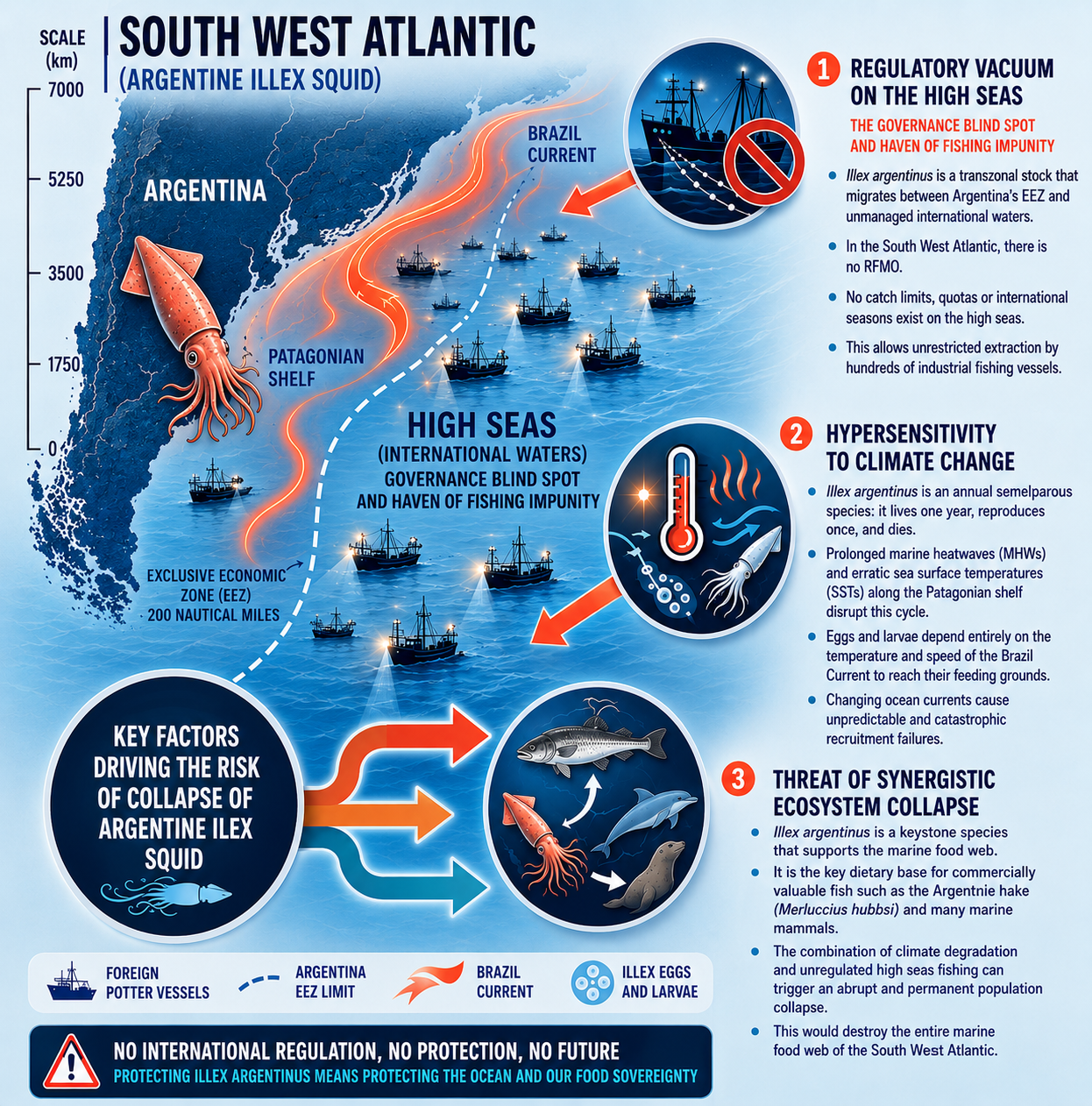
Enlarge the image to view it at full scale
Geopolitical Standoff and UNCLOS Infractions
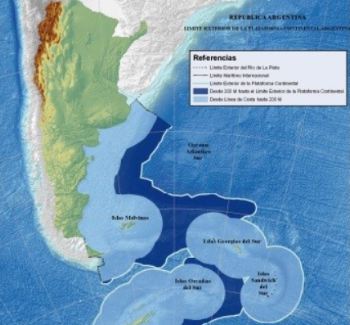
If the solution is an RFMO, the barrier to creating it is entirely political. The absolute obstacle preventing an international treaty is the unresolved sovereignty dispute between Argentina and the United Kingdom over the Falkland Islands (Islas Malvinas). Under the United Nations Convention on the Law of the Sea (UNCLOS), an RFMO must be governed by the "coastal States" bordering the waters in question. Argentina claims exclusive sovereignty over the islands and their surrounding continental shelf, so Buenos Aires flatly refuses to sign any treaty that recognizes the United Kingdom or the Government of the Falkland Islands as a legitimate "coastal State," as doing so would diplomatically imply recognizing British jurisdiction. Conversely, the United Kingdom manages the foreign affairs of the islands and insists that the Falklands represent a distinct maritime entity with its own EEZ, promising never to join an RFMO that excludes the Falklands or compromises the islanders' right to self-determination.
This diplomatic stalemate has completely paralyzed the implementation of maritime control measures. Although international lawyers have raised the idea of an RFMO exclusively for the high seas—a "Southwest Atlantic Fisheries Organization" (SWAFO)—which would bypass national EEZs and include a sovereignty safeguard clause, neither government is willing to assume the domestic political risk of initiating negotiations.
.jpg)
Photo: courtesy Milko Schvartzman
This standoff directly rewards distant-water fishing nations. Fleets of hundreds of industrial vessels exploit this governance blind spot and refuge for fishing impunity to operate completely unchecked at mile 201. While flags from different nations invoke the "freedom of the high seas" under UNCLOS to protect their massive fleets of jiggers and trawlers, their total lack of catch reporting to the neighboring coastal State or cooperation in stock conservation constitutes a flagrant violation of their international preservation duties under that same convention.
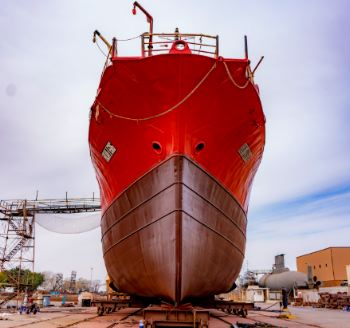
Simultaneously, fishing pressure in the region extends far beyond jiggers due to a massive fleet of bottom trawlers from various countries. These vessels deploy indiscriminate trawling nets that capture vast quantities of squid and other species without any control, severely deteriorating local benthic ecosystems. Currently, these nations lack incentives to push Argentina and the United Kingdom toward a diplomatic resolution, as the creation of an RFMO would impose strict catch limits and international sanctions, perpetuating a scenario of deregulation that benefits their lucrative economic interests.
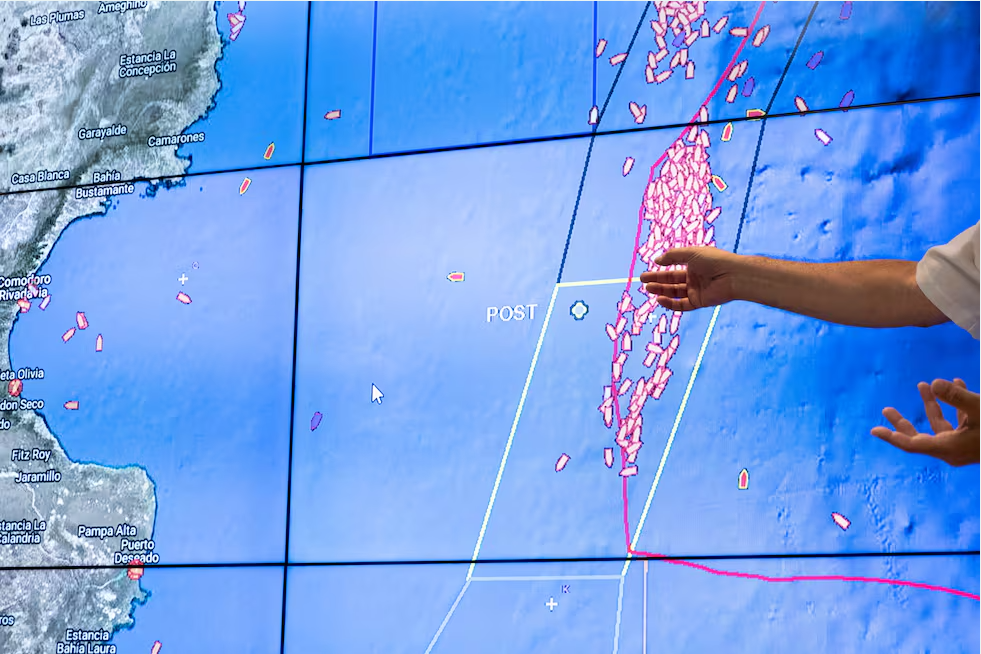
Photo: courtesy Prefectura Naval Argentina (PNA)
Bypassing Politics: The "Tuna Model" and the Rise of "Calamasur del Atlántico"
There are global precedents where highly migratory resources are successfully regulated without triggering explosive sovereignty disputes. The most validated examples are found within tuna RFMOs—such as the Western and Central Pacific Fisheries Commission (WCPFC)—which operate by separating the biology of the resource from geopolitical recognition. To bypass territorial frictions, these frameworks utilize a "Fishing Entities Framework," which allows non-state jurisdictions and distinct maritime economies to fully participate in data exchange and catch limits without requiring members to formally recognize each other's statehood or territorial claims.
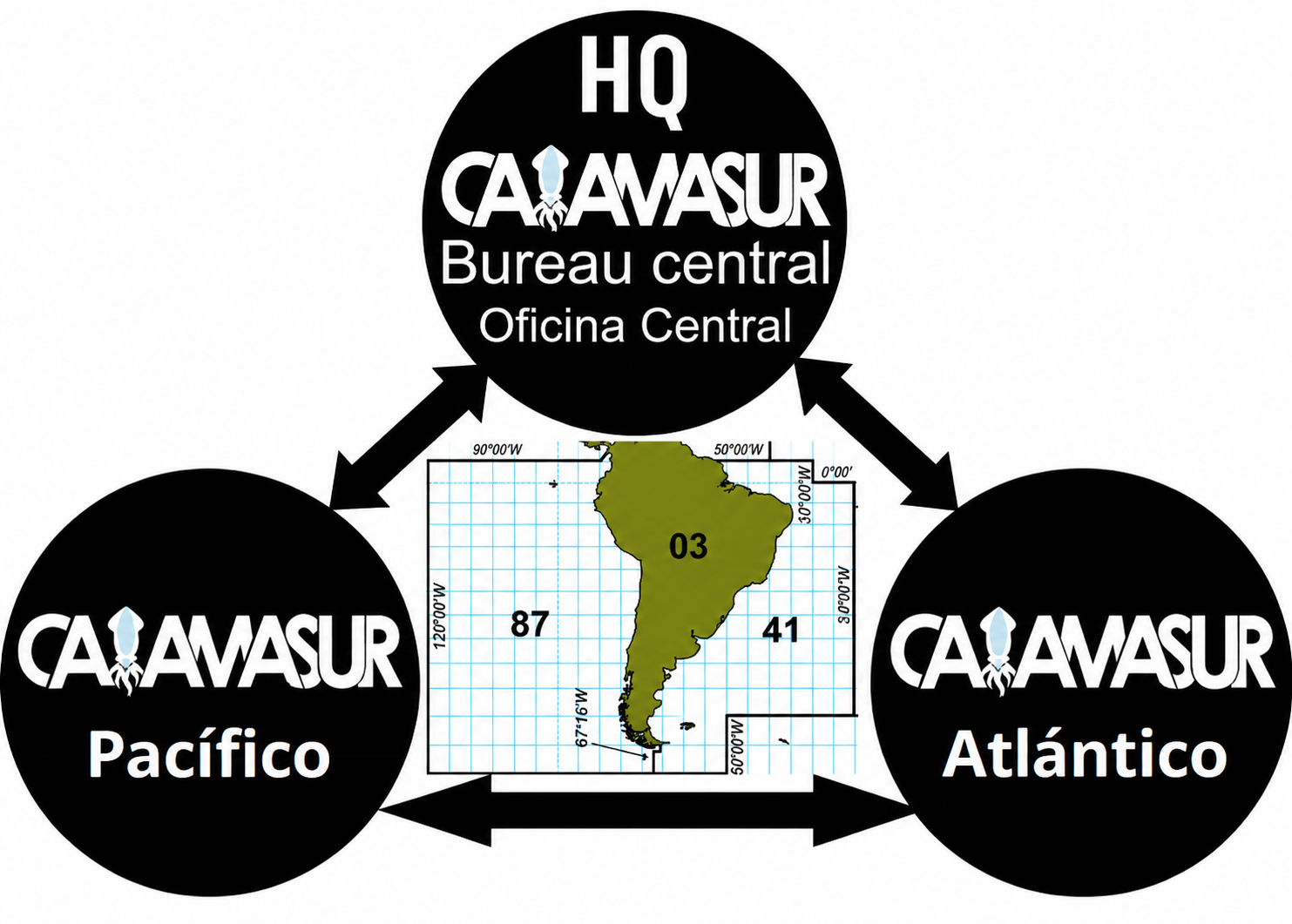
To break the South Atlantic deadlock, it is indispensable to replicate a highly successful model operating just on the other side of the continent: CALAMASUR (Committee for the Sustainable Management of the Giant Squid in the South Pacific). In the Pacific, this powerful alliance of science, industry, and processing sectors from Peru, Chile, Ecuador, and Mexico successfully collaborates on the management and analysis of the giant squid stock, independent of political borders.
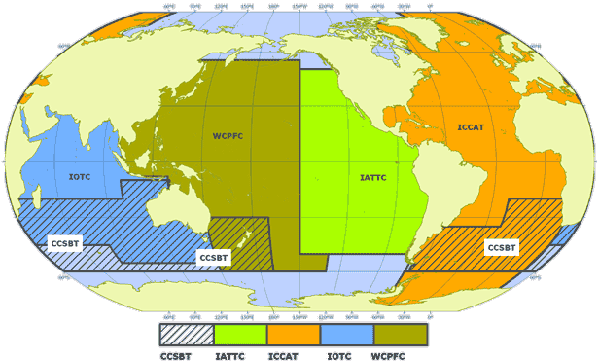
Tuna management is regulated internationally by various specialized organizations; two of them exercise jurisdiction and regulate fisheries within the waters of Argentina, the Falkland Islands, and other sovereign states. (Enlarge the image to view the full-scale map and details of the regulated areas.)
Establishing an independent body called "Calamasur del Atlántico" could turn out to be the ultimate game-changer for the illex squid. By launching a specialized body focused specifically on the sustainability of the resource, international stakeholders could completely bypass diplomatic paralysis by establishing a purely scientific and regulatory framework. It would allow all relevant actors—whether fishing under Asian flags, trawling under European flags, or operating from neighboring zones—to share biological indicators and propose strict quotas on the high seas and along migratory routes, completely isolated from underlying political disputes.
Alfonso Miranda Eyzaguirre will surely welcome this proposal, as a large part of the jigging fleet operating in the Atlantic later moves to the Pacific for the giant squid (Dosidicus gigas) season. In this way, the current CALAMASUR in the Pacific could work in close coordination with the new Calamasur del Atlántico at a regional level, unifying sustainability criteria across both basins.
The Flagrant Lack of Transboundary Scientific Coordination
Despite the existence of these functional global frameworks, the Southwest Atlantic remains alarmingly fragmented. There is a complete lack of scientific coordination or synchronized data exchange among the scientific organizations of Argentina, China, Spain, South Korea, Vanuatu, and the Falkland Islands. The biological reality of the illex squid dictates that it lives, spawns, and migrates across three distinct and highly politicized jurisdictions:
-
Argentine National Waters (EEZ)
-
Adjacent International High Seas (Mile 201 / The Governance Blind Spot)
-
The Zone Autonomously Managed and Administered by the Government of the Falkland Islands (FIG)
By treating these interconnected ocean zones as isolated silos, scientific institutions are operating in the dark. Without combining data on catch volumes, water temperatures, and larval tracking across all three jurisdictions, predicting recruitment failures or accurately mapping the health of the biomass is scientifically impossible.
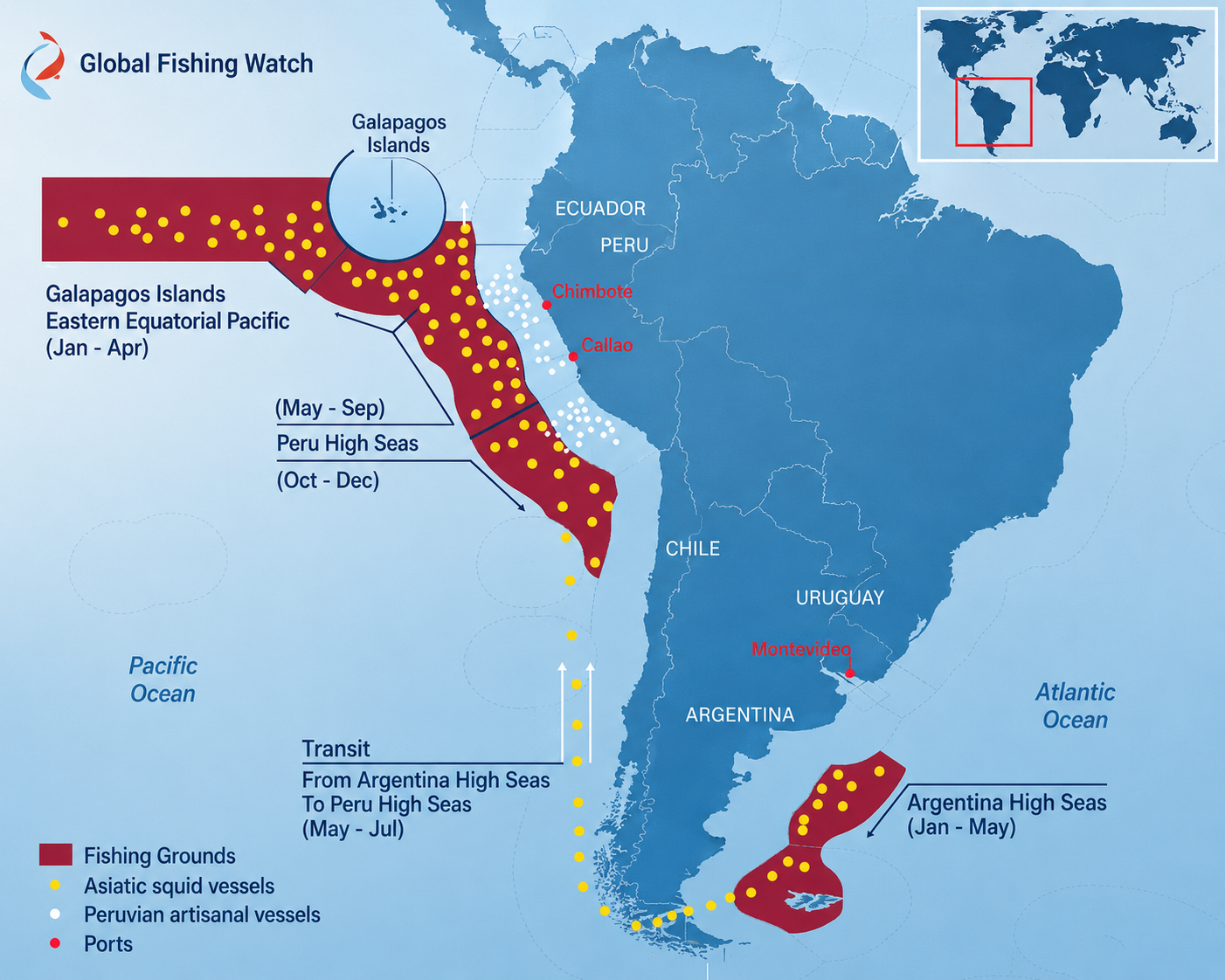
A significant portion of the fleet operating in the Southwest Atlantic shifts seasonally to the Pacific Ocean, completing two dynamic annual cycles to ensure the continuity of squid catches. This map represents a technical adaptation of data from Global Fishing Watch. (Expand or enlarge the image to view the scale of routes and the details of fleet movements)
This dangerous fragmentation connects directly to a profound and unjustifiable "200-mile myopia" on the part of Argentine authorities. By restricting biomass assessments and regulatory frameworks exclusively to data from the Argentine EEZ, local authorities ignore the massive extractive dynamics of multinational fleets at mile 201 and key scientific data from the Government of the Falkland Islands (FIG), which exercises 100% of the control over its local resources. Approving expansions of fishing effort under isolated biological models while omitting the transzonal reality of the squid betrays a complete lack of a holistic vision. It is an identical historical mistake to the one that triggered the irreversible collapse in the Sea of Japan, where nations pretended to manage their borders while turning their backs on the unregulated industrial pillaging occurring right on their doorstep.
Conclusion
Squid do not know how to read maritime borders, nor do they adjust their life cycles to accommodate sovereignty disputes. If Argentina, the various distant-water fishing nations, and the autonomous authorities of the Falkland Islands continue to operate in isolation—prioritizing short-term domestic exploitation and geopolitical positioning over a holistic, transboundary scientific management—the Southwest Atlantic will inexorably suffer the same fate as the Sea of Japan. The illex squid will not survive a 200-mile political myopia. The birth of Calamasur del Atlántico, driven by science and the private sector, is no longer just an idealistic alternative; it is an urgent biological necessity.
Understanding the massive responsibility that falls upon public officials and decision-makers means recognizing that public administration faces constant pressures. Therefore, the core purpose of this analysis is not to point out failures for the sake of criticism, but rather to open a window toward a new regulatory perspective. This proposal seeks to be a superior tool that collaborates with the governments of the region to comprehensively solve an environmental and economic challenge that no longer tolerates delays.
aloubet@seafood.media
Related News:

.png)

editorial@seafood.media
www.seafood.media
|







.png)
.png)
.png)
.png)
 Email
Email Print
Print