|
Copyright © 2025 by International Bank for Reconstruction and Development / The World Bank
Aquaculture Emerges as a Trillion-Dollar Sustainable Investment, Set to Create Millions of Jobs
 (WORLDWIDE, 8/11/2025)
A new report, "Harnessing the Waters: A Trillion Dollar Investment Opportunity in Sustainable Aquaculture," published by the World Bank and the WWF, highlights aquaculture, particularly shrimp farming, as a leading sustainable investment opportunity over the next quarter-century.
The report suggests that the industry could generate up to 22 million new jobs by 2050, offering a critical protein source with one of the lowest greenhouse gas emissions footprints of any food production sector.
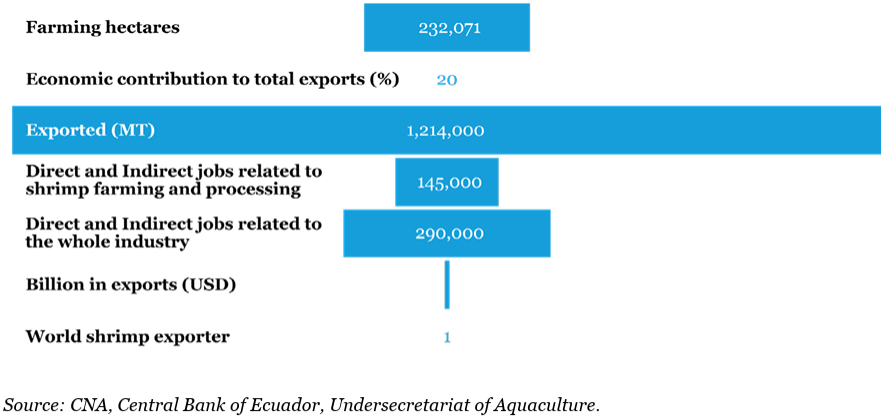
Ecuadorian Shrimp Industry Numbers, Including Direct and Indirect Jobs (2024)
The aquaculture sector, which already supplies most of the world's seafood, is projected to attract up to $1.5 trillion in investment by 2050 to meet a rising global demand for seafood. This growth is positioned to be a major driver of economic development, especially in emerging markets where production is concentrated in rural areas.
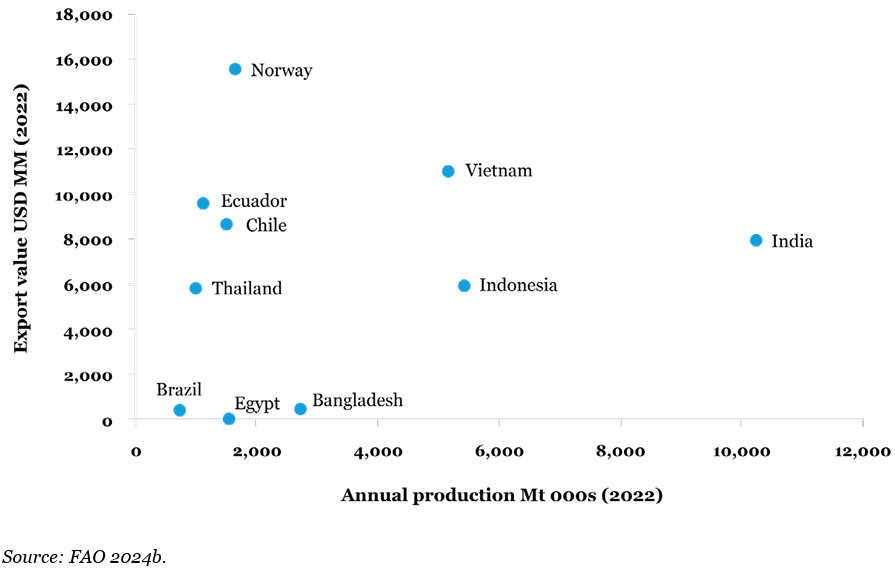
Annual Production Versus Export Value for Top Producer Nations (excl. China) in 2022
Global Leaders and Country-Specific Challenges
The report provides a detailed look into how different nations are navigating the complexities of this rapidly growing industry:
- Ecuador, the world's second-largest shrimp producer, is projected to export 1.477 million tons of shrimp worth $6.3 billion in 2024. Its success is rooted in a medium-density farming model that utilizes electric aeration and efficient feed management, with a feed conversion ratio (FCR) as low as 1.4. The industry, however, faces environmental risks from climate change-related events like El Niño, as well as pressure to diversify its export markets and address past mangrove deforestation.
- China: China’s carp aquaculture sector—black carp, grass carp, silver carp, and bighead carp— began in 475 BCE, when the first known book on aquaculture was written. Today, China leads global carp production, accounting for more than 65 percent of total output, reaching 20.23 million tons in 2021 and valued at more than USUS$46 billion. China’s carp production is the largest single aquaculture sector in the world, a testament to centuries of accumulated knowledge combined with modern techniques (Hua Yue et al., 2024).
- Bangladesh relies on black tiger shrimp for 75% of its seafood exports, valued at $530 million. The country is working to overcome significant barriers to growth, including small-scale production, low productivity (0.37 tons/ha), disease, and limited access to financing. Despite these challenges, the environmental impact of its extensive farming practices is relatively low.
- Thailand's giant freshwater prawn industry recorded a production of 45,815 tonnes in 2023, valued at US$287 million. The industry has advanced through improved breeds like monosex shrimp but must contend with disease, climate issues, and labor shortages.
- Chile: Salmon aquaculture in Chile began in the late 20th century and today the country is the second-largest producer, after Norway, of farmed salmon. By 2022, exports (valued at USUS$6.61 billion) had become the top export after copper. In 2023, production reached 1.08 million tons, industry growth propelled by strategic government support, international collaboration, and technological innovation.
- Viet Nam: Viet Nam is the world’s leading producer of farmed pangasius, accounting for more than 50 percent of global production. Farming evolved from backyard ponds into a major commercial industry in the late 20th century. Viet Nam now exports to more than 140 countries. The pangasius supply chain begins with hatcheries, which produce approximately 30 billion larvae annually. Nurseries—most are in the Mekong Delta—rear fry into fingerlings, survival rates ranging from 10 to 60 percent. Grow-out farms occupy around 5,400 hectares, producing 1.67 million tons of pangasius annually. Water quality management remains a key challenge given the large volumes of water needed to maintain pond health.
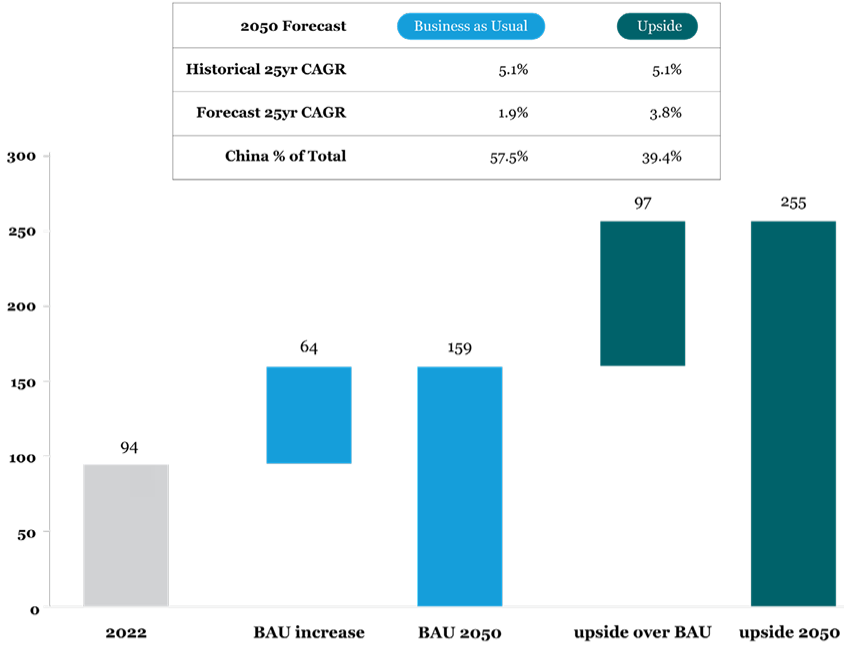
2050 Business as Usual and Upside Case Global Aquaculture Production Projections
Innovations and Financial Pathways
To achieve its full potential, the aquaculture sector requires a transition from small-scale to more intensive production methods. This shift is being supported by innovative financing at scale, especially in emerging markets. Governments and private investors are playing a critical role in reducing risks and fostering a sustainable future for the industry.
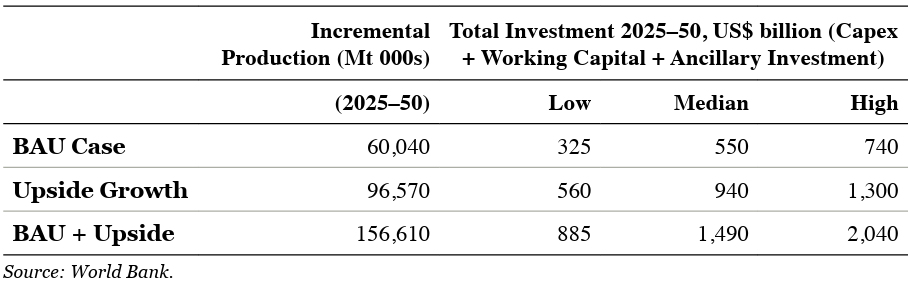
Projections of Aquaculture Production and Investments to 2050
Technological innovations are key to maintaining a low carbon footprint for aquaculture. These advancements include the Internet of Things (IoT) for water quality monitoring, improved feed technologies using alternatives to fishmeal, and the development of genetically improved seed. The report notes that concerted industry efforts have drastically reduced the reliance on fishmeal, with its use in salmon feed declining from 89.4% in 1990 to 22.4% by 2020.
With wild fisheries reaching maximum yield, this new era of sustainable aquaculture is emerging as a critical solution for global food security, economic growth, and environmental protection.
editorial@seafood.media
www.seafood.media
Information of the company:
|
Address:
|
Av. du Mont-Blanc 27
|
|
City:
|
Gland
|
|
State/ZIP:
|
(1196)
|
|
Country:
|
Switzerland
|
|
Phone:
|
+41 22 364 91 11
|
|
Fax:
|
+41 22 364 88 36
|
|
E-Mail:
|
info@panda.org
|
More about: 
|
|
|
|
|








 Print
Print