Welcome   Sponsored By
Subscribe | Register | Advertise | Newsletter | About us | Contact us
If you would like to send us an article, contact Margaret Stacey


Photo: Ohishi Construction

Japanese Submarine Vacuum Technology Enables Seabed Remediation in Salmon Leases and Aquaculture Areas Without Water Turbidity

  (JAPAN, 11/26/2026)

The patented SMC method eliminates up to 82% of red tide cysts and removes sulfides beneath fish farm cages; developer explores international expansion toward key markets including Chile amid tightening environmental regulations

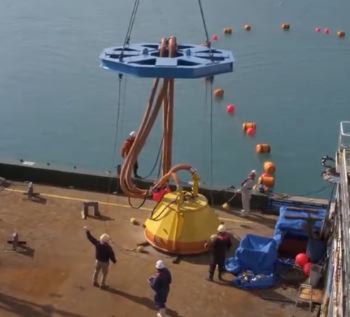
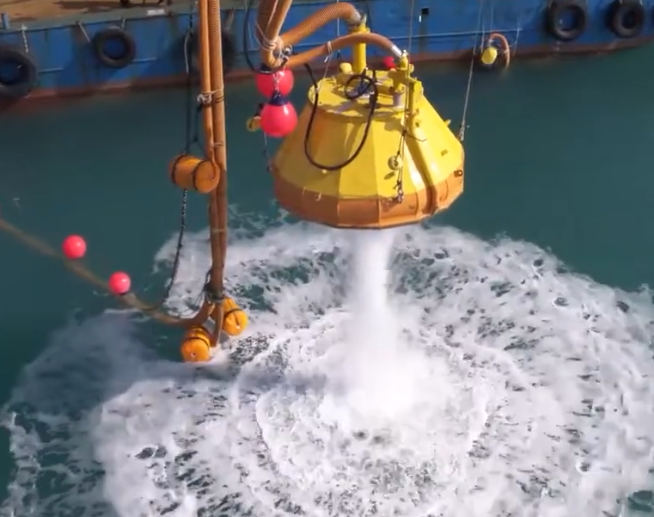
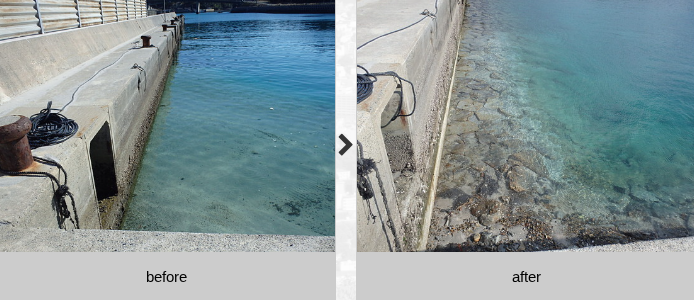
A Japanese technology and industrial consortium led by Ohishi Construction Co., Ltd. (大石建設株式会社), in collaboration with Kyushu University, Nagasaki University, and endorsed by the All Japan Fishing Port Construction Association, has consolidated the deployment of the Submarine Cleaner (SMC) deep seabed remediation method. This thin-layer sealed suction dredging technology removes contaminated sediment, fluid mud, and organic deposits directly from the seafloor without creating turbidity in the water column, completely eliminating the need for silt curtains or secondary dispersion control fences.

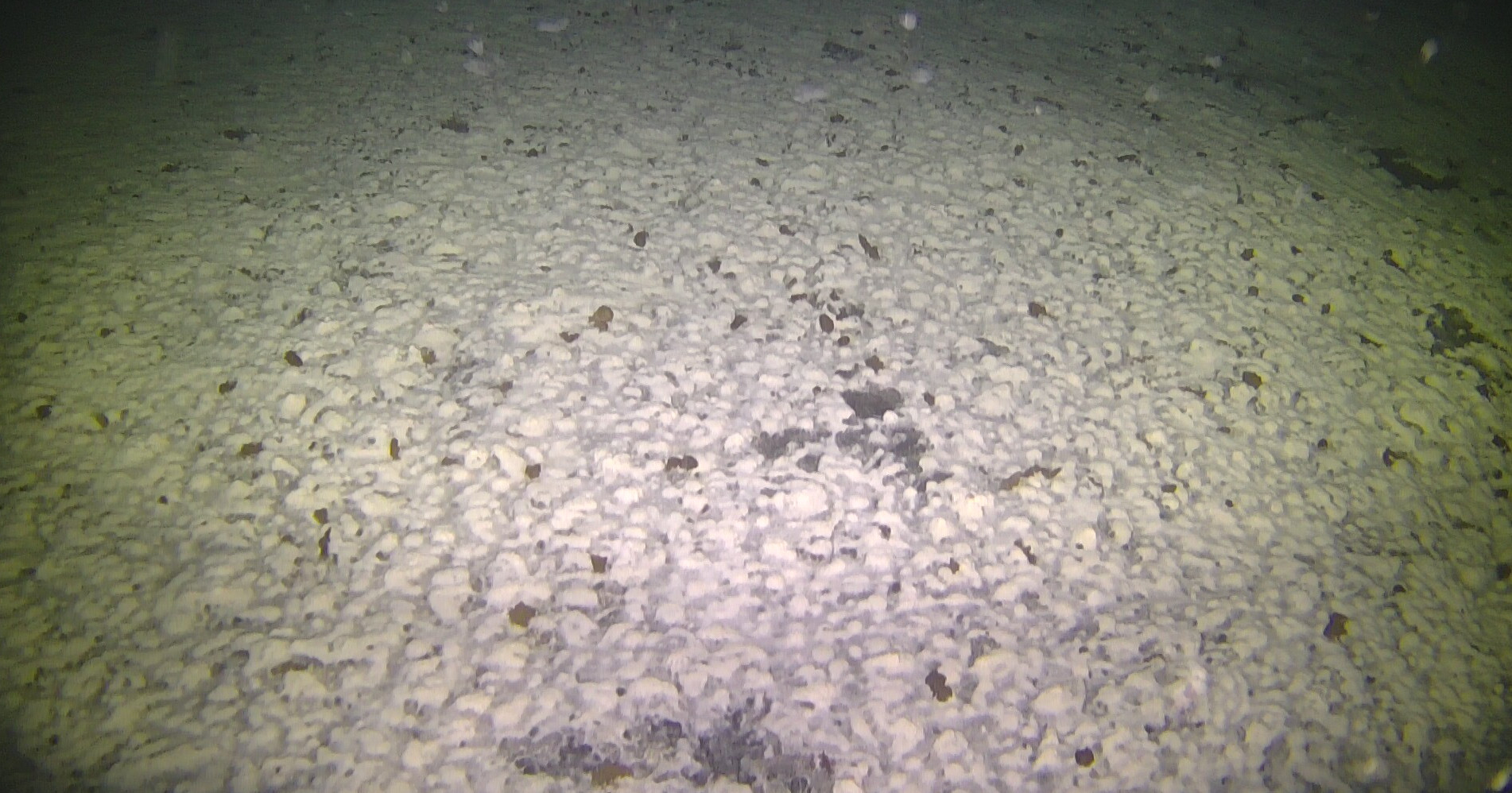
Seabed of the Skyring Sound in Magallanes blanketed by a dense accumulation of uneaten feed pellets and salmon feces, with continuous organic fallout visible. The distinct whitish patches indicate bacterial mats of the genus Beggiatoa. (Photo: courtesy of resumen.cl)

Currently, regulatory frameworks governing salmon farming licenses in Chile and other major producing nations require effective seabed remediation systems to ensure sustainability, benthic oxygenation, and marine biodiversity across production centers. Extensively tested beneath aquaculture cages in Japan with outstanding results, this technology represents an immediate operational solution for the salmon sector. Consequently, the operating company is actively exploring international expansion to introduce its technology and specialized marine bioremediation services to foreign markets.


Photo: Ohishi Construction

Field-Proven Performance in Aquaculture Sites and Algal Bloom Mitigation

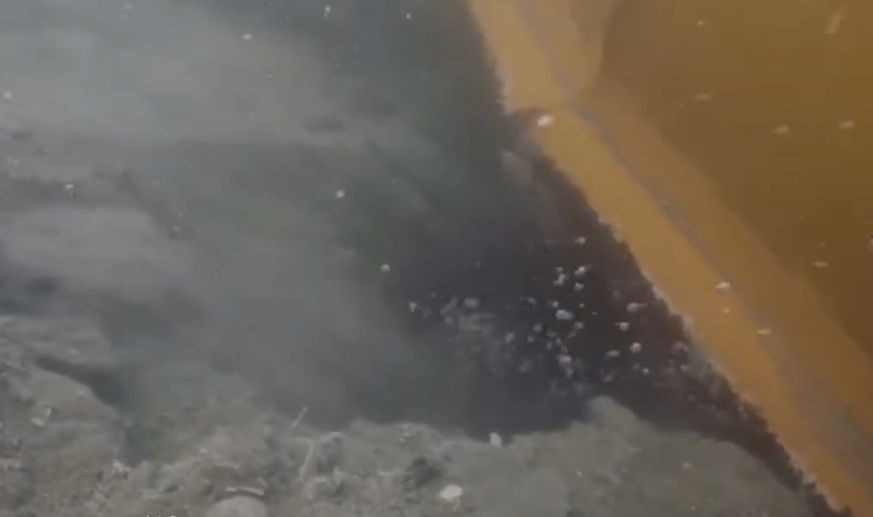
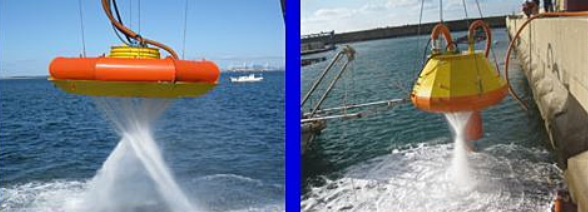
Unlike conventional grab or bucket dredging, the SMC equipment operates via a sealed vacuum hood assisted by high-pressure water jets, precisely lifting and suctioning sedimentary layers between 10 cm and 15 cm thick without dispersing harmful particles. Dredged slurry reaches an approximate solid mud concentration of 60% by wet weight, significantly boosting operational efficiency while reducing the total volume of dredged material requiring onshore disposal.

Technical and operational validations across Japanese coastal waters, fishing grounds, and aquaculture concessions demonstrate the following benchmarks:

  • Harmful Algal Bloom (Red Tide) Control: In official demonstration projects conducted for Kagoshima Prefecture in 2011, the system achieved an 82% removal rate of dormant cysts (Chattonella spp.), eliminating 2.345 billion individual cysts across a 45,000 m² area (reaching up to 85% removal in dedicated sectors of 23,000 m²).

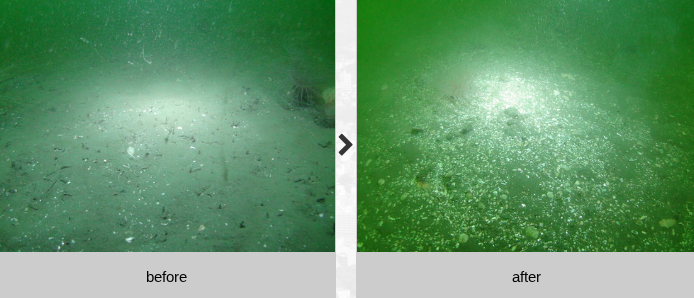
  • Sediment Bioremediation and Sulfide Reduction: Across port seabeds and aquaculture sites—such as works completed at the Port of Hakata for the Ministry of Land, Infrastructure, Transport and Tourism (MLIT)—the treatment reduced sedimentary sulfide concentrations by 72% (from 0.548 mg/g to 0.155 mg/g dry basis), total nitrogen (T-N) by 38% (from 2,850 mg/kg to 1,760 mg/kg), and total phosphorus (T-P) by 21% (from 730 mg/kg to 580 mg/kg), fully restoring the native substrate of clean sand and shell fragments.

  • Nuclear Decontamination: In recovery trials following the 2011 disaster in Fukushima (2012), the system removed 88% of radioactive cesium accumulated on the surface silt of reservoirs and coastal basins without causing seawater turbidity.

  • Hazardous Substance Sequestration: The methodology effectively extracts and isolates dioxins, polychlorinated biphenyls (PCBs), heavy metals, and persistent organotin compounds including tributyltin (TBT).

Photo: Ohishi Construction

Operational Capacity, Technical Versatility, and Cost Structure

The SMC method holds registered patents (including Patent No. 4494320) and was certified under the Japanese government's NETIS new technology platform (Registration QSK-100004), earning prestigious awards from both the Ministry of Agriculture, Forestry and Fisheries (MAFF) and MLIT.

The system is suspended from a standard 250 t crane barge (operating in standard shifts of 6 h to 8 h) and integrates adjustable ballast tanks that prevent the suction head from sinking into ultra-soft benthic substrates. Furthermore, the targeted water jet exerts a mechanical tilling action that aerates and reactivates the seabed without leaving deep craters or topographic depressions prone to hypoxia.

Photo: Ohishi Construction

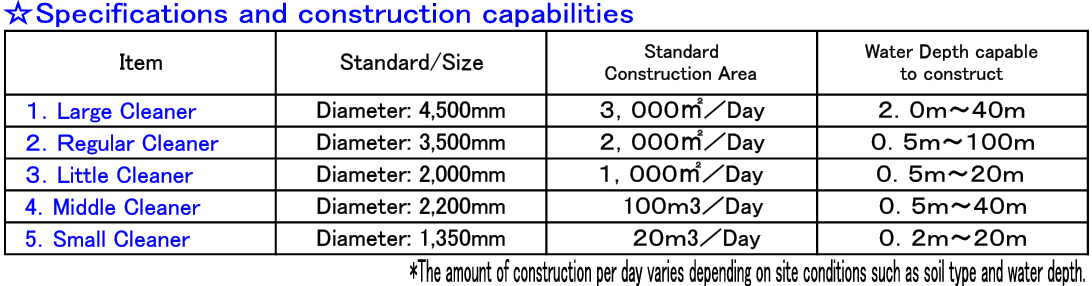
The technical catalog features five equipment configurations:

  • Large Cleaner: Diameter of 4,500 mm, treatment capacity of 3,000 m²/day (approx. 500 m²/h) across working depths of -2.0 m to -40 m continuous (operable at greater depths via stamping).

  • Regular Cleaner: Diameter of 3,500 mm, capacity of 2,000 m²/day operating from -0.5 m to -100 m in depth.

  • Little Cleaner: Diameter of 2,000 mm, coverage of 1,000 m²/day at depths between -0.5 m and -20 m.

  • Middle Cleaner: Diameter of 2,200 mm, volumetric rating of 100 m³/day for riverbed and port maintenance between -0.5 m and -40 m.

  • Small Cleaner: Diameter of 1,350 mm, rating of 20 m³/day for shallow zones from -0.2 m to -20 m.

The baseline dredging unit cost recorded under NETIS for depths up to 20 m is 564 JPY/m² (approx. US$ 3.60/m²), excluding mobilization, assembly, demobilization, and specialized engineering oversight.

Photo: Ohishi Construction

Onshore, the pumped slurry undergoes chemical-free separation tailored to site logistics: filtration settling basins for spacious port yards or compact mechanical separation plants where waterfront space is constrained. In both configurations, clarified seawater is continuously recirculated back to the submarine cleaner to feed the high-pressure agitation jets, establishing a fully closed-loop system free of secondary effluent discharge into the coastal environment.


🇯🇵 日本語 (Japanese Version) | AIによる自動翻訳

日本の海底吸引清掃技術、海水を濁らせることなくサケ養殖場や漁場の底質浄化を実現

特許取得のSMC工法が赤潮プランクトン休眠接合子を最大82%、養殖生け簀下の硫化物を大幅除去;チリなど主要市場における環境規制強化を受け、海外展開を本格検討

大石建設株式会社(長崎県佐世保市)を筆頭に、九州大学、長崎大学との産学官連携により開発され、一般社団法人全国漁港漁場協会環境保全工法研究会が推薦するサブマリンクリーナー(SMC)工法の展開が本格化しています。本工法は、薄層密閉吸引技術により、海水を一切濁らせることなく海底に堆積した有害物質、浮遊泥、有機物を直接除去できる画期的なシステムであり、汚濁防止膜や防汚フェンスの設置を不要とします。

現在、チリをはじめとする世界各国のサケ・マス類養殖場では、免許更新や環境認証の基準として底質の保全、酸素供給、生物多様性の維持を目的とした浄化対策が厳格に義務付けられています。日本国内の魚類養殖生け簀下で既に多数の実績を上げ、極めて高い環境修復効果が立証されている本技術は、サケ養殖産業にとって直接的な解決策となります。これを受け、開発企業では本技術および環境修復サービスの海外展開を本格的に推進しています。

養殖場および赤潮対策で実証された浄化能力

従来のグラブ浚渫やバケット工法とは異なり、SMC工法はジェット水流と密閉型吸引フードを組み合わせ、海底表層の堆積物を10 cmから15 cmの薄層単位で精密に吸引します。周囲への微粒子拡散が一切なく、吸い上げた泥水中の含泥率は湿重量比で約60%に達するため、陸上での処理土量を大幅に削減し、総処分コストを抑制します。

日本各地の海域や漁場、港湾で実施された施工実証では、以下の顕著な成果が確認されています。

  • 赤潮プランクトン休眠接合子(シスト)の除去: 2011年、鹿児島県の発注により実施された実証試験において、赤潮原因プランクトン(Chattonella spp.)のシストを82%除去することに成功。施工面積45,000 m²において推定23億4,500万個のシストを回収し、特定工区(23,000 m²)では最大85%の除去率を達成しました。

  • 底質改善および硫化物除去: 国土交通省九州地方整備局博多港湾・空港整備事務所発注の浮遊泥除去工事等の実績において、底質中の硫化物濃度を72%削減(乾燥重量比0.548 mg/gから0.155 mg/gへ低減)。全窒素(T-N)を38%(2,850 mg/kgから1,760 mg/kg)、全リン(T-P)を21%(730 mg/kgから580 mg/kg)減少させ、清浄な砂および貝殻が露出する健全な海底環境を再生しました。

  • 放射性物質(セシウム)の除去: 2012年の東日本大震災復興検証試験(福島県)において、水域を濁らせることなく表層泥に沈着した放射性セシウムの88%を除去しました。

  • 有害物質・環境ホルモンの無害化: ダイオキシン類、ポリ塩化ビフェニル(PCB)、重金属、有機スズ化合物(TBT)などの底質汚染物質を確実に吸引・無害化処理します。

施工性能、仕様ラインナップ、および経済性

本技術は特許第4494320号等の特許を取得済みであり、国土交通省の新技術情報提供システムNETIS(登録番号:QSK-100004)に登録されていたほか、国土技術開発賞優秀賞(国土交通大臣表彰)やインフラメンテナンス大賞(農林水産大臣賞)を受賞しています。

本機は250 t吊りクレーン船等に吊り下げて連続施工(標準実働6時間〜8時間)され、本体に装備されたバラストタンクの調整により、超軟弱地盤上でも沈下することなくスムーズに自走・移動します。また、ジェット水流による適度な耕耘効果が海底を活性化させ、貧酸素水塊の発生源となる掘削窪地を形成しません。

用途および現場条件に応じた5種類の仕様がラインナップされています。

  • 大型クリーナー(Large): 直径4,500 mm、施工能力3,000 m²/日(約500 m²/h)、対応水深-2.0 m〜-40 m(連続施工。-40 m以深はスタンピング工法により対応)。

  • 標準クリーナー(Regular): 直径3,500 mm、施工能力2,000 m²/日、対応水深-0.5 m〜-100 m。

  • 小型クリーナー(Little): 直径2,000 mm、施工能力1,000 m²/日、対応水深-0.5 m〜-20 m。

  • 中型容積クリーナー(Middle): 直径2,200 mm、施工容積100 m³/日、対応水深-0.5 m〜-40 m。

  • 超小型容積クリーナー(Small): 直径1,350 mm、施工容積20 m³/日、対応水深-0.2 m〜-20 m。

NETIS積算基準における水深20 m以浅の直接施工単価は564円/m²(約US$ 3.60/m²)であり、別途機材輸送費、組立解体費、技術管理費等が加算されます。

揚泥された泥水は、陸上ヤードの条件に応じて無薬剤にて固液分離処理されます。広大な用地が確保できる場合は多層ろ過池方式、狭小用地の場合は密閉型機械ろ過プラント方式を採用。分離された清澄海水はリサイクルドレッジシステムにより海底クリーナーの噴射水として循環再利用され、沿岸生態系への二次排水負荷をゼロに抑える完全循環システムを確立しています。


🇨🇳 中文 (Simplified Chinese Version) | 由人工智能自动翻译

日本海底负压抽吸技术实现三文鱼养殖海区与海床清淤零浊度作业

专利SMC工法可清除高达82%的赤潮孢囊及网箱底层硫化物;面对智利等国日益严格的环保法规,研发企业加速推进国际化市场布局

由日本大石建设株式会社(大石建設株式会社)主导,联合九州大学、长崎大学开展产学研合作,并获全日本渔港渔场协会(All Japan Fishing Port Construction Association)权威推荐的海底吸尘器(SMC)工法,现已实现全面工程化应用。该系统采用薄层密闭负压抽吸专利技术,在清淤过程中完全不引起水体浑浊,能直接清除海底沉积的有害物质、浮泥及有机废弃物,施工全程无需布设防污膜或防扩散屏障。

当前,智利及其他主要产区对于三文鱼养殖特许经营牌照的合规监管日趋严苛,强制要求养殖场配备高效的海床底质清理方案,以确保海洋底栖生态的含氧量与生物多样性。该技术此前已在日本各类海产养殖网箱下方进行多次实地作业,取得了优异的生态修复成效。鉴于这一技术优势,该企业目前正积极拓展海外市场,为全球水产养殖业提供专属的海底清淤与生物修复解决方案。

在水产养殖区及赤潮防治中得到充分验证的高效清淤性能

与传统的抓斗式或挖斗式开敞疏浚不同,SMC工法利用密闭式作业罩结合高压水射流,以10 cm至15 cm的薄层精度对底泥进行剥离与抽吸,杜绝颗粒物的二次悬浮与扩散。抽提取出的泥水混合物含泥率高达60%(湿重比),大幅提升了单机作业效率,并显著减少了陆上脱水处置的废土总量。

在日本各重点海域、渔业水域及港口的实际工程中,该技术取得的关键指标如下:

  • 清除赤潮毒藻休眠孢囊: 2011年在鹿儿岛县官方防赤潮底质改良工程中,该设备成功清除了82%的赤潮致灾藻类(Chattonella spp.)休眠孢囊;在45,000 m²的总作业区域内累计清除23.45亿个孢囊(在23,000 m²的局部重点区块清除率高达85%)。

  • 底质生态修复与硫化物消除: 在国土交通省九州地方整备局发起的博多港底泥治理等工程中,底质硫化物含量显著降低72%(干重由0.548 mg/g降至0.155 mg/g),总氮(T-N)降低38%(由2,850 mg/kg降至1,760 mg/kg),总磷(T-P)降低21%(由730 mg/kg降至580 mg/kg),使受污染海床完全恢复为清洁的贝壳沙底质。

  • 核辐射沉积物治理: 在2012年针对东日本大震灾福岛受污染水体的修复实验中,该设备在水体完全不发生浑浊的前提下,成功清除了水底表层泥沉积中88%的放射性铯。

  • 重污染化学物阻断: 可对二𫫇英、多氯联苯(PCB)、重金属以及三丁基锡(TBT)等有机锡环境激素实现同步抽吸与无害化处置。

设备规格体系、施工产能与经济指标

SMC工法已获得多项发明专利(包括第4494320号专利),曾列入日本国土交通省新技术信息系统NETIS(注册号:QSK-100004),并先后荣获国土交通大臣奖(国土技术开发奖优秀奖)与农林水产大臣奖(基建维护大奖)。

作业设备悬吊于250 t常规起重驳船(标准工班为6小时至8小时),机身配备可调式配重压载水舱,确保在超软弱土质海床上平稳滑行而不发生沉陷陷机。同时,定向射流具有对底泥松土耕耘的作用,在活化底质的同时杜绝产生易引发水体缺氧的凹坑。

该技术体系涵盖五种不同作业规格:

  • 大型机(Large Cleaner): 罩体直径4,500 mm,作业面积3,000 m²/天(约500 m²/h),连续作业水深-2.0 m至-40 m(超过-40 m水深采用点夯作业模式)。

  • 标准机(Regular Cleaner): 罩体直径3,500 mm,作业面积2,000 m²/天,适用作业水深-0.5 m至-100 m。

  • 小型机(Little Cleaner): 罩体直径2,000 mm,作业面积1,000 m²/天,适用作业水深-0.5 m至-20 m。

  • 中型机(Middle Cleaner): 罩体直径2,200 mm,作业体积100 m³/天,适用河道及港池水深-0.5 m至-40 m。

  • 微型机(Small Cleaner): 罩体直径1,350 mm,作业体积20 m³/天,适用浅水区-0.2 m至-20 m。

根据NETIS核算基准,在水深20 m以浅海域进行薄层清除的基础综合造价约为564日元/m²(约合3.60美元/m²),大型设备进出场运输、现场组装拆卸及技术管理费按工程实际另行计算。

抽升至陆地的泥水混合物全程采用物理无化学药剂方案进行分离处理:场地开阔时构建专用多级过滤池,场地受限时则配备占地极小的模块化机械脱水装置。脱水分离后的澄清海水通过闭式循环系统直接回注至海底吸尘器作为射流水源,杜绝任何二次污水外排,实现了全流程闭环环保施工。

editorial@seafood.media
www.seafood.media


Information of the company:
Address: 4-52 Huis Ten Bosch-cho
City: Sasebo
State/ZIP: Nagasaki (859-3243)
Country: Japan
Phone: +81 0956-58-7733
Fax: +81 0956-58-7734
More about:


Location:


 Print


Click to know how to advertise in FIS
MORE ARTICLES
Japanese Submarine Vacuum Technology Enables Seabed Remediation in Salmon Leases and Aquaculture Areas Without Water Turbidity
Japan's Nissui wins award for world-first technology boosting fish oil EPA recovery by 1.3 times
Dongwon Explores New Acquisitions but Keeps StarKist Sale on Hold
Iceland Tests Drying of Land-Based Aquaculture Waste to Evaluate Use as Fertilizer
Galician Cannery Frinsa Strengthens Portuguese Presence with US$34.56m Injection
Nissui Tests Fish Format Targeting Younger Consumers
Thai Union Selects Zunibal to Upgrade Electronic Monitoring Across Supplier Longliners in the Indian Ocean
Khyber Aquaculture Secures FSSAI Approval to Market Packaged Trout and Plans Exclusive Srinagar Retail Outlet
Koasa Shoji Begins Construction of Seaweed Processing Plant in Indonesia with a 2 Billion Yen Investment
Bendito Mar Becomes First Mexican Farm to Join ASC Improver Programme
Guangdong Feed and Liufu Technology sign strategic agreement to deploy AI smart aquaculture
Thai Union Ingredients launches marine platform targeting the global longevity market
Zalmhuys Group acquires majority stake in BML Food Group to boost European expansion
Toyo Reizo tests fresh Moroccan bluefin tuna transported by air in Japan
SeaMe develops self-releasing buoy technology to eradicate ghost gear and protect marine resources
Ode achieves historic annual profitability in cod farming
Cooke Accelerates Transformation from Seafood to High-Value Nutrition and Ingredients
BuyCo and Searoutes: Decarbonising container shipping, one booking at a time
Nichimo drives land-based aquaculture (RAS) in Japan with its 100% domestic modular technology
The kingfish Company completes EUR 21 million private placement and strengthens its financial structure
More Articles...

Lenguaje
FEATURED EVENTS
  
TOP STORIES
Japan's Nissui wins award for world-first technology boosting fish oil EPA recovery by 1.3 times
Japan New column-packing method in high-purity refining process aims to offset rising fish oil costs and secure stable pharmaceutical raw material supplies. TOKYO — Two employees of Nissui Co., L...
Argentina Updates Certification and Onboard Processing Standards for Patagonian Toothfish
Argentina The Secretariat of Agriculture, Livestock and Fisheries Officializes Resolution 231/2026, Establishing New Thermal, Operational, and Packaging Guidelines to Access the Argentine Food Seal for Shipment...
Chinese Scientists Uncover How Oceanic Shifts Reshape Fishing Grounds for Tuna, Squid, and Small Pelagics
China Four research studies from Shanghai Ocean University link El Niño, marine heatwaves, and oceanic eddies to the distribution of commercial species. A new model improves the explanation of squid ...
Taste and Price Define European Plant-Based Food Choices Amid Uneven Adoption
European Union A report by Schouten Europe based on data from GFI Europe, Circana, and Smart Protein reveals that initial trial does not translate into regular grocery basket habits Photo: Stockfile/FIS The alte...
 

Umios Corporation  (formerly Maruha Nichiro Corporation)
Nichirei Corporation - Headquarters
Pesquera El Golfo S.A.
Ventisqueros - Productos del Mar Ventisqueros S.A
Wärtsilä Corporation - Wartsila Group Headquarters
ITOCHU Corporation - Headquarters
BAADER - Nordischer Maschinenbau Rud. Baader GmbH+Co.KG (Head Office)
Inmarsat plc - Global Headquarters
Marks & Spencer
Tesco PLC (Supermarket) - Headquarters
Sea Harvest Corporation (PTY) Ltd. - Group Headquarters
I&J - Irvin & Johnson Holding Company (Pty) Ltd.
AquaChile S.A. - Group Headquarters
Pesquera San Jose S.A.
Nutreco N.V. - Head Office
CNFC China National Fisheries Corporation - Group Headquarters
W. van der Zwan & Zn. B.V.
SMMI - Sunderland Marine Mutual Insurance Co., Ltd. - Headquarters
Icicle Seafoods, Inc
Starkist Seafood Co. - Headquearters
Trident Seafoods Corp.
American Seafoods Group LLC - Head Office
Marel - Group Headquarters
SalMar ASA - Group Headquarters
Sajo Group - Sajo Industries Co., Ltd
Hansung Enterprise Co.,Ltd.
BIM - Irish Sea Fisheries Board (An Bord Iascaigh Mhara)
CEFAS - Centre for Environment, Fisheries & Aquaculture Science
COPEINCA ASA - Corporacion Pesquera Inca S.A.C.
Chun Cheng Fishery Enterprise Pte Ltd.
VASEP - Vietnam Association of Seafood Exporters & Producers
Gomes da Costa
Furuno Electric Co., Ltd. (Headquarters)
NISSUI - Nippon Suisan Kaisha, Ltd. - Group Headquarters
FAO - Food and Agriculture Organization - Fisheries and Aquaculture Department (Headquarter)
Hagoromo Foods Co., Ltd.
Koden Electronics Co., Ltd. (Headquarters)
A.P. Møller - Maersk A/S - Headquarters
BVQI - Bureau Veritas Quality International (Head Office)
UPS - United Parcel Service, Inc. - Headquarters
Brim ehf (formerly HB Grandi Ltd) - Headquarters
Hamburg Süd Group - (Headquearters)
Armadora Pereira S.A. - Grupo Pereira Headquarters
Costa Meeresspezialitäten GmbH & Co. KG
NOAA - National Oceanic and Atmospheric Administration (Headquarters)
Mowi ASA (formerly Marine Harvest ASA) - Headquarters
Marubeni Europe Plc -UK-
Findus Ltd
Icom Inc. (Headquarter)
WWF Centroamerica
Oceana Group Limited
The David and Lucile Packard Foundation
Ajinomoto Co., Inc. - Headquarters
Friosur S.A. - Headquarters
Cargill, Incorporated - Global Headquarters
Benihana Inc.
Leardini Pescados Ltda
CJ Corporation  - Group Headquarters
Greenpeace International - The Netherlands | Headquarters
David Suzuki Foundation
Fisheries and Oceans Canada -Communications Branch-
Mitsui & Co.,Ltd - Headquarters
NOREBO Group (former Ocean Trawlers Group)
Natori Co., Ltd.
Carrefour Supermarket - Headquarters
FedEx Corporation - Headquarters
Cooke Aquaculture Inc. - Group Headquarters
AKBM - Aker BioMarine ASA
Seafood Choices Alliance -Headquarter-
Austevoll Seafood ASA
Walmart | Wal-Mart Stores, Inc. (Supermarket) - Headquarters
New Japan Radio Co.Ltd (JRC) -Head Office-
Gulfstream JSC
Marine Stewardship Council - MSC Worldwide Headquarters
Royal Dutch Shell plc (Headquarter)
Genki Sushi Co.,Ltd
Iceland Pelagic ehf
AXA Assistance Argentina S.A.
Caterpillar Inc. - Headquarters
Tiger Brands Limited
SeaChoice
National Geographic Society
AmazonFresh, LLC - AmazonFresh

Copyright 1995 - 2026 Seafood Media Group Ltd.| All Rights Reserved.   DISCLAIMER